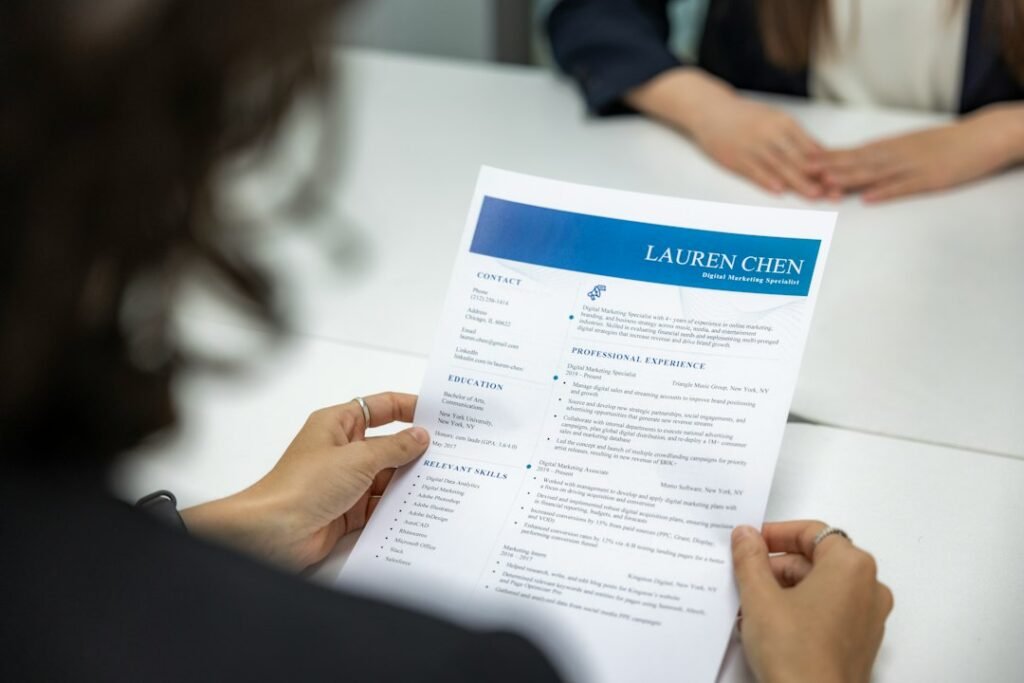
An academic CV is not the same document as a one-page corporate résumé. Its job is to show your academic preparation, research experience, methods, publications, teaching, awards and other evidence that matters to a university, supervisor or scholarship panel.
The challenge is deciding what deserves space. Many international applicants either make the CV too thin because they force it into one page, or too long because they include every certificate and school activity they have ever completed.
A strong academic CV is selective, evidence-based and easy to scan.
Start with the purpose of the CV
The same person may need different versions for a taught master’s programme, a research PhD and a scholarship. The core history remains the same, but the emphasis changes.
For a research PhD, methods and research experience may matter most. For a scholarship, leadership, service and awards may deserve more prominence. For a master’s application, academic preparation and relevant projects can be central.
Academic CV versus résumé
A résumé is normally short and tailored heavily to a specific job. An academic CV can be longer because it documents scholarly activity in more detail.
There is no rule that every academic CV must be exactly two pages. Length should reflect the amount of relevant evidence you actually have.
What goes at the top
Use your full name, professional email address, phone number if appropriate, city/country and links that add genuine value, such as ORCID, Google Scholar, a research portfolio or LinkedIn.
You normally do not need to include marital status, religion, passport number or other personal details unless a specific application form requires them separately.
Write a short academic profile only if it adds value
A two- or three-line profile can help explain your field, current status and research direction. Avoid generic statements such as “hardworking and passionate student seeking opportunities.”
A useful profile says what you study, what you have worked on and where your research interests are heading.
Education should be easy to understand
List degrees in reverse chronological order. Include:
- degree title;
- institution;
- country;
- dates;
- classification, GPA or result where useful;
- thesis title if relevant;
- supervisor where relevant.
Help international readers interpret your grades
If your grading system is unfamiliar internationally, you can include the scale briefly, such as “4.6/5.0” or “First Class Honours.” Do not convert your GPA to another system unless the university explicitly asks you to.
Research experience deserves detail
For each substantial research project, show the question, methods, your role and outcome. A project entry is stronger when it explains what you actually did instead of only repeating the project title.
Thesis and dissertation work
If your thesis is relevant to the application, give it its own line or short section. Mention methods, dataset, fieldwork, laboratory techniques or theoretical framework where useful.
Publications
Use a consistent citation style. Separate peer-reviewed publications from manuscripts under review, preprints, book chapters or other outputs.
Do not list a paper as “published” if it has only been submitted.
Conference presentations
Presentations, posters and invited talks can be valuable, especially for early-career applicants with limited publications. Make clear whether you presented the work or were simply a co-author.
Research methods and technical skills
List methods you can actually use. Examples include:
- statistical analysis;
- qualitative interviewing;
- GIS;
- Python or R;
- laboratory assays;
- archival research;
- systematic review methods;
- econometrics;
- CAD or simulation tools.
Avoid rating yourself “expert” unless you can defend the claim.
Teaching experience
If you have worked as a tutor, teaching assistant, lecturer or trainer, include the course, level, institution and responsibilities.
For PhD applications that may involve teaching assistantships, this can be especially useful.
Professional experience
Work outside academia belongs on an academic CV when it supports the application. A public-health applicant, for example, may have professional field experience that matters more than a minor undergraduate society role.
Scholarships and awards
List competitive awards with the awarding body and year. If the award is not self-explanatory, add one short phrase explaining its significance.
Do not list every online course
Certificates should be included only when they materially strengthen your application. Ten unrelated short courses can make the CV look unfocused.
Professional memberships
Memberships can be relevant in regulated or research fields, but simply paying a membership fee is not the same as holding a competitive distinction.
Leadership and service
For scholarship applications, leadership and community engagement can deserve a separate section. Use roles where you had real responsibility and can show what you contributed.
Languages
List languages when relevant and describe proficiency honestly. If the programme asks for an official English test, the test result belongs in the application even if your CV says you are fluent.
References
Some academic CVs list referees; others say “references available on request.” Follow the application instructions. If names are required, obtain permission first and use institutional contact details where possible.
Should you include a photograph?
In many international academic applications, a photograph is unnecessary and sometimes discouraged. Follow the norms and instructions of the destination country and institution rather than copying a local employment CV format automatically.
Should you include date of birth?
Usually not unless explicitly requested. Keep sensitive personal information out of the CV when it is not relevant to academic assessment.
File format
PDF is usually the safest choice unless the application asks for another format. It preserves layout across devices and operating systems.
File name
Use something clear such as Daniel_Okafor_Academic_CV.pdf. Avoid filenames such as CV-final-version3-new.pdf.
Formatting matters
Use consistent headings, dates, spacing and bullet styles. An academic CV does not need decorative graphics. Clear hierarchy is more useful than visual complexity.
Keep dates consistent
Choose one date format and use it throughout. If there are gaps, do not manipulate dates to hide them.
Tailor the order
A PhD applicant can place research experience directly after education. A scholarship applicant may bring awards and leadership higher. A master’s applicant with little research can emphasise relevant coursework and projects.
Do not copy the job description style of a corporate résumé
Academic readers want evidence of intellectual preparation. “Responsible for teamwork and communication” is less useful than “analysed 2,300 survey responses in R and co-authored the final research report.”
Quantify only when the number means something
Numbers can improve clarity, but forced metrics look artificial. State the number of participants, datasets, courses taught or grants awarded when it helps the reader understand scale.
Keep terminology understandable internationally
Local job titles, degree classifications or institutional abbreviations may not make sense abroad. Spell out unfamiliar terms the first time.
What if you have no publications?
Many master’s and early PhD applicants have no formal publications. Do not invent a “research papers” section. Emphasise thesis work, projects, research methods, conference posters or relevant professional work instead.
What if your GPA is not strong?
You should not hide official results required by the application. On the CV, you can still highlight stronger recent performance, thesis quality, research experience and relevant achievements where they genuinely exist.
What if you are changing fields?
Use the CV to show the bridge. Bring forward coursework, projects or professional experience that explain why the transition makes academic sense.
For scholarship applications
Scholarship panels often look beyond grades. A useful scholarship CV can include leadership, service, awards and professional impact in addition to academic evidence.
Use StepOut’s Scholarship Application Checklist to make sure the CV aligns with the rest of the application.
For PhD applications
Prioritise research preparation. A potential supervisor should be able to see quickly what you studied, what methods you know, what research you completed and how your interests connect to the proposed doctorate.
If you are contacting supervisors, pair the CV with StepOut’s Professor Outreach Guide.
For master’s applications
Relevant modules, final-year projects and professional experience can matter more than a long publication section. Keep the document proportional to your career stage.
Common academic CV mistakes
- Using a generic one-page employment résumé.
- Including irrelevant personal information.
- Claiming unpublished work as published.
- Listing dozens of weak certificates.
- Using inconsistent dates.
- Hiding gaps with misleading timelines.
- Overdescribing routine duties.
- Failing to explain research methods.
- Using unexplained local abbreviations.
- Sending the same version for every purpose.
A strong section order for an early-career applicant
- Name and contact details.
- Short academic profile.
- Education.
- Research experience.
- Thesis or major projects.
- Publications/presentations if applicable.
- Technical/research skills.
- Teaching or professional experience.
- Awards and scholarships.
- Leadership/service where relevant.
- Languages.
- References if required.
Final editing pass
Read the CV from the evaluator’s perspective. Can they understand your academic trajectory in under a minute? Can they find your strongest research evidence quickly? Is every section helping the application?
If an item does not strengthen the reader’s understanding of your preparation, it may not need to be there.
How to tailor the same CV for different applications
Tailoring does not mean rewriting your history. It means changing emphasis. For a research PhD, move research experience, methods and publications higher. For a taught master’s programme, highlight academic preparation and relevant projects. For a scholarship, bring awards, leadership and community work forward if those are part of the criteria.
How to write strong research-experience bullets
A useful bullet usually contains the task, method and outcome. Instead of “assisted with research,” write what you analysed, collected, built or tested. For example: “Cleaned and analysed household survey data in R to examine predictors of school attendance; contributed figures to the final departmental report.”
When to include coursework
Relevant coursework can help when you are early in your academic career or changing fields. List only modules that explain your preparation for the programme. A long list of every undergraduate course adds little value.
How to present ongoing work
Use clear labels such as “manuscript in preparation,” “under review,” “working paper” or “conference poster.” This lets you show active research without overstating the status.
What to do about gaps
You do not need to explain every quiet period inside the CV. But if a gap is large and relevant, use dates honestly and let the personal statement or application form provide context if requested. Manipulating dates is riskier than a truthful gap.
Check the CV against the programme criteria
Before submitting, place the programme or scholarship criteria beside your CV. Can the evaluator find evidence for the skills and experiences the application values? If not, reorder the document or add relevant evidence that is currently buried.
Keep an editable master CV
Maintain one complete version containing all education, projects, awards, publications and experience. Create shorter tailored copies from that master. This reduces the risk of losing important details or accidentally changing dates across applications.
Frequently asked questions
How long should an academic CV be?
Long enough to document relevant academic evidence clearly. Early-career applicants are often around two to three pages, but there is no universal rule.
Should I include publications that are only submitted?
Only if clearly labelled as submitted or under review. Do not present them as published.
Can I use the same CV for scholarships and PhD applications?
The core information can be the same, but the order and emphasis should be tailored.
Do I need a photo?
Usually not unless the institution or local convention specifically expects one.
Reader-first principle: an academic CV should make the evaluator’s job easier. Show the strongest evidence of your preparation clearly, accurately and without decoration that hides the substance.
For the broader international-study decision path—from university choice and applications to costs, visas and arrival planning—use StepOut Travel’s Study Abroad for International Students pillar.